Emergency Road Repairs Done Properly
A failed road surface rarely gives much notice. One day it is a small crack or shallow depression. The next, it is standing water, loose material, vehicle damage, trip risks and a growing safety issue for staff, residents or the public. That is why emergency road repairs need to be handled quickly, but also properly. A fast response matters, but so does choosing a repair that will hold up under traffic, weather and daily use.
For site managers, landlords, developers and property owners, the pressure is usually immediate. You need to keep access open, reduce liability and avoid further deterioration. The challenge is that not every road defect needs the same response. Some failures can be made safe and patched effectively on the day. Others need a temporary repair followed by a planned resurfacing programme once conditions and access allow.
When emergency road repairs are actually needed
Not every damaged surface is an emergency, but plenty of them become one if left too long. Deep potholes are the obvious example, especially where cars, vans or heavy vehicles pass over the same point repeatedly. Edges breaking away on access roads, failed utility reinstatements, surface rutting, drainage-related washouts and sudden tarmac collapse can all move from minor defect to urgent problem very quickly.
The main trigger is risk. If the road surface is unsafe for vehicles or pedestrians, if water is accelerating the damage, or if access to homes, businesses, yards or car parks is being restricted, the repair usually cannot wait. On commercial sites, the cost of delay often goes beyond the repair itself. Vehicle damage claims, delivery disruption and avoidable health and safety issues soon make a bigger dent than the original defect.
In busy areas, timing also matters. A defect near entrances, loading areas, schools, retail parks or shared residential access points is far more likely to need immediate attention than the same defect on a lightly used private road.
What causes sudden road surface failure
Surface failure is often blamed on age alone, but that is only part of the picture. Water is one of the biggest causes. Once water gets into cracks, joints or weak spots, it starts to undermine the layers below. In colder conditions, freeze-thaw cycles can make that worse. Under traffic, the weakened area breaks up fast.
Weight and movement also play a part. Heavy lorries, frequent turning, braking and repeated use at gateways or junctions put extra stress on tarmac and asphalt. If the original build-up was not right for the traffic load, the surface may fail early. The same applies where drainage is poor. Even a well-laid surface will struggle if water is allowed to sit on it day after day.
Sometimes the issue sits below the top layer. If the sub-base has softened, shifted or been poorly compacted, surface patching alone may not be enough. That is why proper assessment matters before the repair starts.
Emergency road repairs: patch, resurface or rebuild?
This is where experience counts. The aim is not simply to cover the damage and move on. The aim is to restore safety and serviceability in a way that makes sense for the site, the budget and the likely lifespan of the repair.
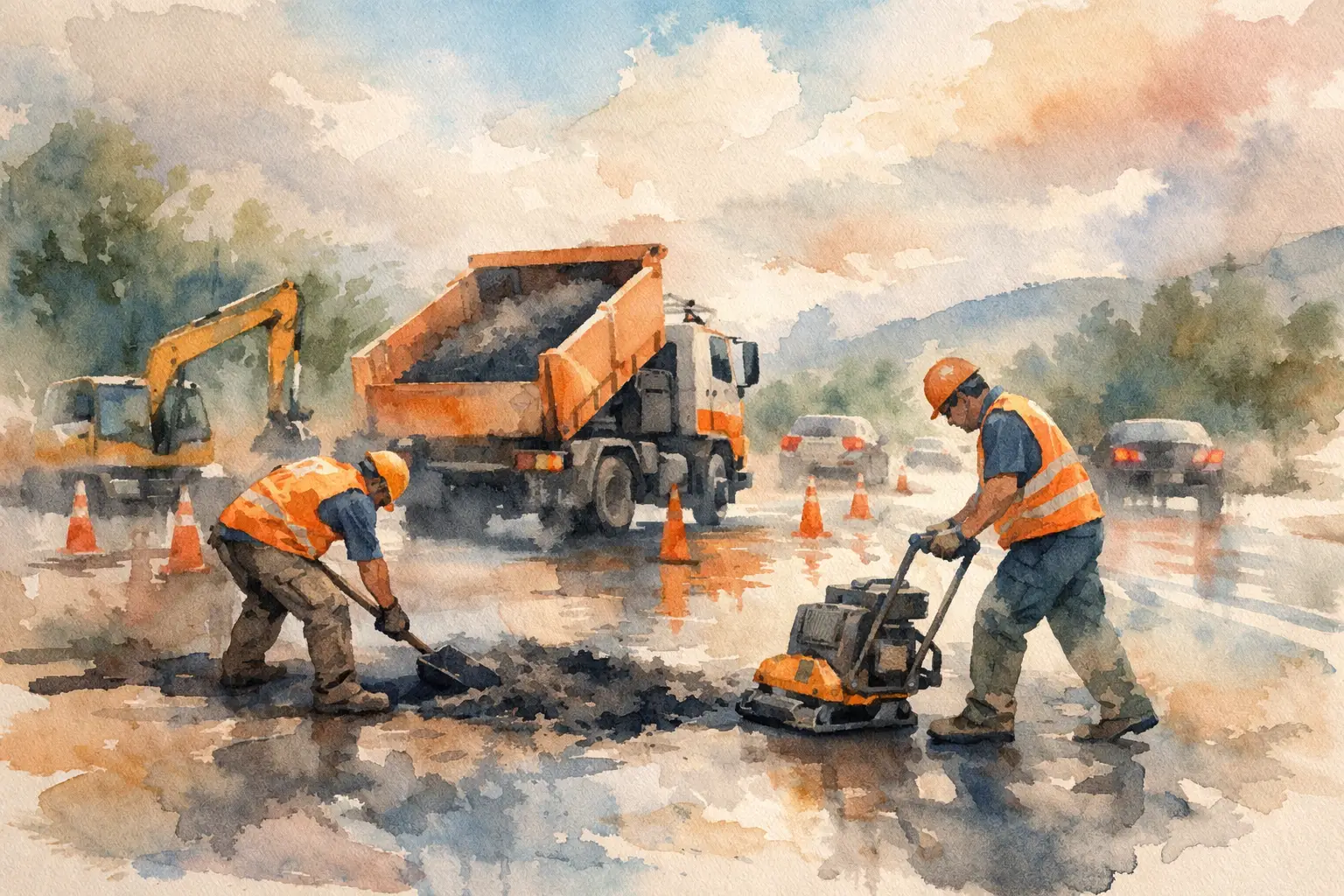
A localised patch repair is often the right choice when the defect is contained and the surrounding surface is still sound. The damaged area is cut out cleanly, failed material is removed, the base is checked, and new material is laid and compacted to match the existing level. Done properly, this gives a neat, durable repair and removes the immediate hazard.
Resurfacing is usually the better option when multiple defects are appearing across the same stretch of road or car park. If one pothole is repaired today but the surrounding surface is already cracking and fretting, more failures are likely to follow. In that case, a larger treatment area is often more cost-effective than repeated call-outs.
Reconstruction becomes necessary when the lower layers have failed. You can usually spot this where there is visible movement, widespread sinking, severe edge breakdown or repeated potholes in the same location. A surface-only fix may make the area safe for a short period, but it will not solve the root problem.
There is always a trade-off. A temporary repair can be the right decision when access must stay open immediately, weather conditions are poor, or a larger project needs planning. But temporary should mean exactly that. If the underlying failure is significant, a permanent repair should be scheduled before the defect returns.
What a proper emergency repair should include
Speed matters, but shortcuts usually come back to bite. A proper emergency repair starts with making the area safe, then identifying the extent of the failure rather than just the visible hole or crack. Surface damage often spreads beyond the obvious edges.
The failed section should be cut back to sound material, not patched loosely around broken edges. The base needs checking for softness, contamination or water ingress. If that layer is unstable, it should be repaired before the new surface course is installed. Correct compaction is also essential. Without it, the new material can deform under traffic sooner than expected.
Drainage should never be ignored. If standing water helped create the problem, patching the surface without addressing runoff, levels or blocked drainage will only buy time. A decent contractor will tell you that plainly, even if it means recommending more work than a simple patch.
Minimising disruption during urgent works
For many clients, the repair is only half the issue. The other half is keeping the site operational. On a commercial premises, school access road, industrial yard or shared residential entrance, disruption needs managing just as carefully as the surfacing itself.
That can mean working in phases, repairing high-risk sections first, or scheduling around delivery windows and peak traffic times. In some cases, out-of-hours work is the best answer. In others, temporary traffic management or partial closures are enough to keep things moving safely.
This is where a responsive contractor adds real value. The best emergency jobs are not just quick. They are organised. Materials, labour, plant and access arrangements need to line up properly so the repair is completed with as little downtime as possible.
Why cheap emergency fixes often cost more
When a road defect appears suddenly, there is a temptation to go for the quickest and cheapest option available. That can work for a very short-term make-safe measure, but it is rarely the cheapest route over time.
Poorly prepared patches fail early. Loose edges open up. Water gets back in. Vehicles track material out of the repair. Before long, the same area needs attention again, often with a larger and more expensive defect than before. Repeated reactive patching can end up costing more than carrying out the correct repair the first time.
There is also the reputational side for commercial and public-facing sites. A broken access road or tired car park sends a message about standards. If customers, visitors or tenants are using the space, appearance matters alongside safety.
When to act before a defect becomes urgent
The best way to manage emergency road repairs is to prevent as many of them as possible. That does not mean resurfacing every area at the first sign of wear, but it does mean dealing with early warning signs before they become expensive.
Cracking, standing water, loose chippings, surface fretting and small edge failures should all be looked at promptly. These are often the stage where a planned repair is still straightforward. Wait too long, and the same defect can turn into a call-out, traffic disruption and a larger bill.
For property portfolios, commercial estates and managed sites, periodic inspection makes practical sense. It helps spot areas where patching is still viable and where larger planned works would offer better value. Across Scotland and the North of England, weather and traffic can be hard on external surfaces, so a bit of foresight goes a long way.
A reliable contractor should be able to tell you honestly whether the defect needs immediate action, a temporary repair, or a more permanent resurfacing solution. That straightforward advice is often what clients need most when a surface fails without warning.
If you are dealing with sudden road damage, the priority is simple: make it safe, fix the cause where possible, and avoid paying twice for the same problem. A quick repair is useful. A repair that lasts is better.