How Pavement Drainage Prevents Surface Failure
Water sitting in wheel tracks, against kerbs or at the entrance to a driveway is more than an appearance issue. It is often the first visible sign that pavement drainage is not doing its job. Left unresolved, standing water works through joints and cracks, weakens the foundations below and turns a sound surface into a costly repair.
For roads, car parks, yards and driveways across Scotland and the North of England, drainage needs to be considered as part of the surfacing work itself. A quality asphalt finish can only perform as well as the ground and drainage arrangement beneath it. The aim is straightforward: move rainwater safely off the surface, prevent it from saturating the construction layers, and direct it to an appropriate outlet.
Why Pavement Drainage Matters
Asphalt and tarmacadam are durable materials, but they are not a cure for poor water management. Water can enter through open joints, service covers, cracks, surface defects and the pavement edges. Once it reaches the sub-base or underlying ground, repeated traffic loading causes the weakened material to move.
This often starts with slight depressions where water gathers. The surface then flexes under cars, vans and lorries, allowing more water in. In colder weather, freeze-thaw action can widen small defects. The result is familiar: fretting, cracking, rutting, potholes and localised settlement.
Drainage also affects safety and day-to-day use. Ponding can make walking areas slippery, hide potholes, splash pedestrians and create nuisance at shopfronts or house entrances. On busy commercial sites, water running across access routes can carry dirt and loose material into gullies, increasing the risk of blockages and ongoing maintenance.
The cost difference is significant. Clearing a blocked channel or correcting a local low spot is usually far less disruptive than excavating failed areas, rebuilding the foundation and resurfacing the pavement later.
Start With the Route Water Will Take
Effective pavement drainage begins before the first load of aggregate is laid. The site must be assessed for existing levels, ground conditions, kerbs, buildings, drainage runs and a suitable legal discharge point. Simply creating a slope is not enough if that slope sends water towards a property, neighbouring land or a boundary with nowhere for it to go.
The required solution depends on the size and use of the area. A domestic driveway may need a channel drain across the entrance and controlled drainage within the property. A car park may require several gullies, carefully designed falls and inspection points that can be maintained without closing the entire site. Larger access roads and yards can need more substantial surface-water systems, especially where heavy vehicles operate.
Surface Falls Must Be Deliberate
The finished surface should have consistent falls that encourage water to travel towards channels, gullies or drainage edges. Flat-looking areas are not necessarily flat, but the fall needs to be sufficient and accurate enough to avoid puddles after rainfall.
Crossfalls move water sideways across the pavement, while longitudinal falls carry it along the direction of travel. In many schemes, both are needed. The layout must also take account of entrances, thresholds, disabled access, kerb lines and existing manholes. A fall that works well on paper can cause problems if it directs water across a pedestrian route or leaves a low point beside a doorway.
There is no sensible one-size-fits-all gradient. Steeper falls can move water quickly but may be unsuitable for certain access areas. Shallow falls can work on well-constructed surfaces, but they demand accurate levels and regular maintenance. Site inspection and proper setting out make the difference.
Choose the Right Collection Method
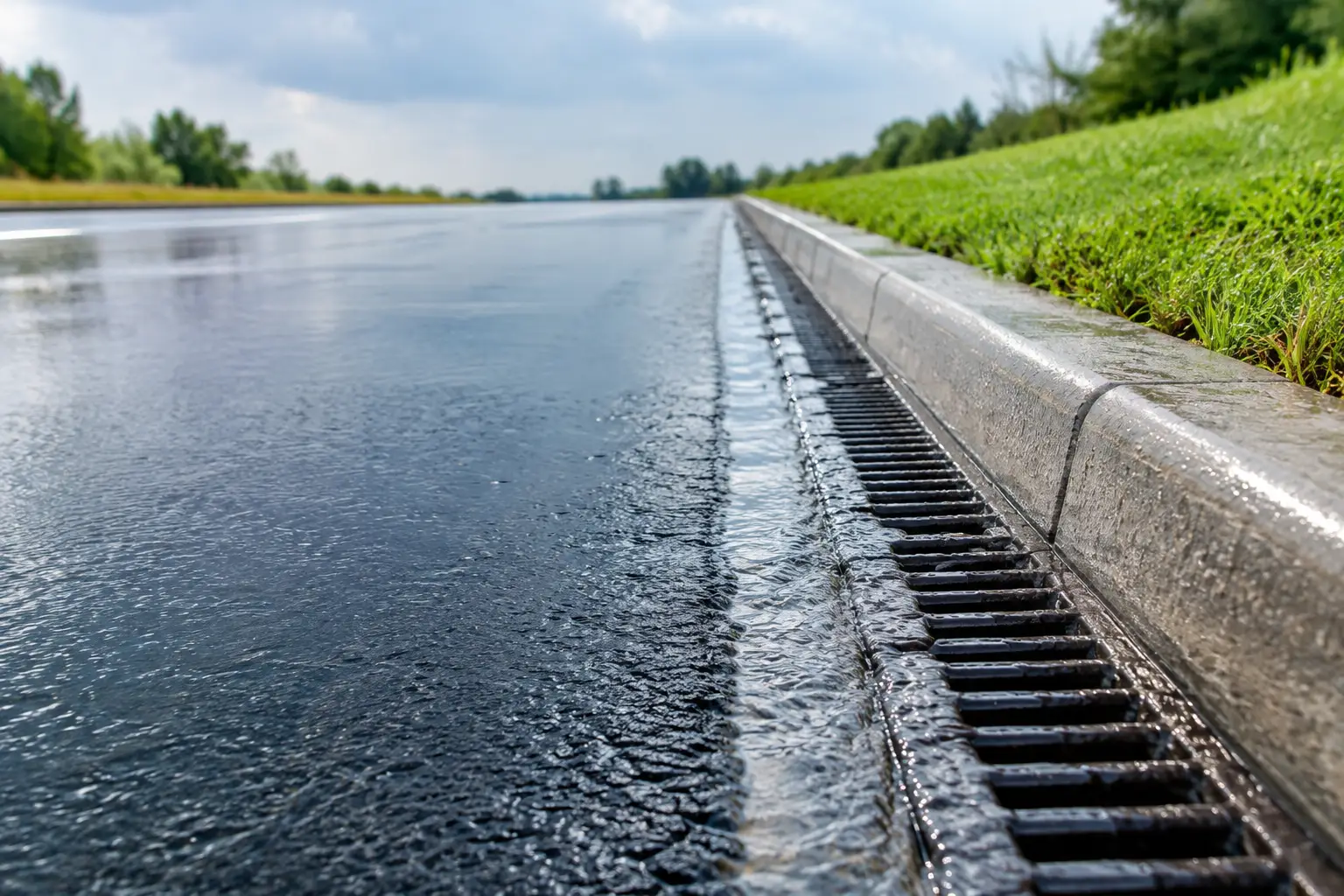
Water needs somewhere to go once it leaves the surface. Linear channel drains are often suitable at driveway entrances, garage doors, loading areas and points where runoff must be intercepted. Gullies are commonly used in roads and car parks, collecting water at low points and connecting to underground pipework.
Slot drains can offer a neat finish where a conventional grated channel is undesirable, while filter drains and land drains may help protect the pavement edges or manage water within the ground. Catchpits and inspection chambers are useful where sediment is likely to build up and the system needs routine cleaning.
Each option has trade-offs. Grated channels are easy to identify and maintain, but their gratings need to suit the traffic loading. Gullies are effective across larger areas, but poorly positioned gullies will not solve inaccurate surface levels. Land drainage can reduce saturation in the subgrade, but it will not remove ponding caused by an uneven asphalt surface.
Pavement Drainage Is Also Below the Surface
A surface that drains well can still fail if the layers underneath remain wet. The sub-base supports the asphalt and helps distribute traffic loads. If it becomes saturated, its bearing capacity falls and the pavement is more likely to deform.
This is particularly relevant on clay ground, at sites with a high water table, and where old construction layers have poor drainage. Edge drains, geotextiles, suitable aggregate and correctly formed sub-base layers can all have a role, depending on the ground conditions and design requirements.
The pavement edges deserve close attention. Water can enter where asphalt meets kerbs, walls, concrete slabs, ironwork or unsealed verges. Sound jointing and edge restraint help keep water out while maintaining the shape of the finished surface. If water is able to track beneath the edge, local failures can develop even where the main carriageway or driveway appears intact.
Common Signs That Drainage Needs Attention
Not every puddle means a full reconstruction is required, but recurring water problems should not be ignored. Standing water that remains well after rain, dark damp patches, loose surface stone, cracking around gullies and settlement near channels are all warning signs.
Blocked gullies are one of the most common causes. Leaves, silt, litter and loose aggregate reduce their capacity, causing water to back up across the pavement. Cleaning may solve the immediate issue, but it is worth checking why the debris is collecting there. Poor falls, damaged grates or runoff from unpaved ground can make the problem return.
Depressions should also be investigated rather than simply overlaid. If the low area has formed because the foundation has weakened, a thin layer of new asphalt may temporarily improve the appearance but will often sink again. Proper repair may involve cutting out the affected area, rebuilding the base, reinstating drainage and resurfacing to the correct level.
Getting Drainage Right on New Surfacing Work
The best time to address drainage is during planned resurfacing, driveway installation or car park construction. Excavation gives access to the layers below, allowing drainage pipework, channels and suitable foundations to be installed before the final surface is laid.
For a domestic driveway, the priorities are usually preventing runoff towards the house, avoiding water discharge onto the public highway and creating a clean, usable entrance. The design should also account for parked vehicles, garage thresholds and existing paths.
For commercial premises, the brief is wider. Site managers need drainage that works under regular traffic, remains accessible for maintenance and does not create trip hazards or operational bottlenecks. Delivery yards and service roads may need stronger channel systems than pedestrian areas, while car parks need gully positions that do not sit directly in the most heavily trafficked wheel paths where practical.
Careful sequencing matters. Drainage runs and gullies must be installed to the correct levels before the sub-base and asphalt courses are compacted. Rushing this stage can leave channels proud of the surface, gullies too high to collect water or pipework with inadequate fall. These details are difficult and expensive to correct once the surfacing is complete.
Maintenance Protects the Investment
Even well-designed drainage needs inspection. Channels and gullies should be cleared regularly, particularly in autumn and after severe weather. Keep grates free from leaves, soil, loose chippings and site debris, and look for damaged covers, broken channel units or failed sealant around joints.
It is also worth checking the surface after heavy rainfall. This is when minor level issues become clear. Early action on a small depression, crack or blocked outlet can prevent water from reaching the sub-base and extending the repair area.
Where resurfacing, pothole repair or drainage improvements are needed, EB Road Surfacing can assess the condition of the area and provide a practical solution suited to the traffic, ground conditions and available drainage route. The right approach protects the surface, improves safety and avoids paying twice for work that should have been done once.
A dry, free-draining pavement is rarely noticed, which is exactly the point. When water is guided away properly from the start and the system is maintained, the surface stays safer, stronger and better value for years to come.