Repairing Tarmac Edge Damage for Lasting Results
A sound driveway or access road can start to fail at its weakest point: the edge. Repairing tarmac edge damage promptly stops a narrow break from becoming loose aggregate, standing water, potholes and an avoidable trip hazard. For homeowners, site managers and property owners, the right repair protects both the surface and the investment beneath it.
Why tarmac edges break down
Tarmac relies on support at its sides. Where the edge is exposed, unsupported or regularly driven over, the material can crack and crumble. Once water enters those cracks, it can soften the foundation and weaken the bond between the tarmac and the underlying base.
Vehicle movements are a frequent cause. Reversing lorries, delivery vans and cars cutting tight corners put concentrated weight directly onto the edge of a driveway, car park or access route. This is particularly common where there is no kerb, edging restraint or properly compacted verge alongside the surface.
Poor drainage also accelerates deterioration. Water running off a slope, pooling next to the tarmac or escaping from damaged gullies can wash out the supporting ground. During colder weather, trapped water can freeze and expand, opening cracks further. On rural lanes and commercial yards, soft verges and heavy traffic often create the same problem from both sides.
Age matters, but it is not always the main issue. A relatively new surface can suffer edge failure if the base was too narrow, poorly compacted or left without adequate side support. An older surface may still be suitable for repair if the rest of the tarmac remains firm and structurally sound.
Assessing tarmac edge damage before repairs
The visible break is only part of the picture. Before choosing a repair, check whether the damage is confined to the outer strip or whether cracking and movement extend into the main carriageway, driveway or parking area. A local repair is effective only when it is tied into stable material.
Light scuffing at the edge, with no cracks or softness underfoot, may only need the verge rebuilt and compacted to provide support. However, loose, fretted tarmac should not simply be covered with a thin layer of new material. Anything weak must be cut back first, otherwise the fresh patch will fail along with the old edge.
Signs that a more substantial repair may be needed include:
- cracks running in from the edge towards the centre of the surface;
- dips, rutting or movement when vehicles pass over the area;
- water sitting against the broken edge after rainfall;
- exposed or soft foundations beneath the tarmac;
- repeated failures in the same location.
Where these issues are present, the repair should address drainage and the sub-base as well as the finished surface. Covering over a failed foundation may improve appearance for a short time, but it will not provide a lasting result.
Repairing tarmac edge damage the right way
A professional edge repair begins by marking a straight, sound line behind the damaged section. The failed tarmac is then saw-cut and removed. A clean vertical edge gives the new material something solid to bond against and produces a neater, stronger finish than breaking out loose material by hand.
The exposed base is inspected next. If it is dry, firm and properly compacted, it may only need levelling before new tarmac is laid. If it has been washed out, softened or disturbed by traffic, it should be excavated to the required depth and rebuilt with suitable aggregate. The aggregate is installed in layers and compacted properly, creating a stable foundation rather than a temporary fill.
Once the base is ready, fresh tarmacadam is laid to match the existing surface level and compacted while it is workable. The joint between old and new material needs careful attention. A properly prepared joint reduces the risk of water entering the repair and prevents the patch from breaking away under wheel loads.
Finally, the edge requires restraint. Depending on the site, this could mean rebuilding and compacting the adjoining verge, installing kerbs or edging, widening the hardstanding, or creating a suitable drainage channel. The best option depends on how the area is used. A domestic driveway may need a strengthened turning point, while a commercial access route used by delivery vehicles may need a wider, thicker construction with kerbed edges.
When patching is enough
A local patch is generally the most cost-effective option where the damage is limited, the surrounding tarmac is in good condition and the cause of failure can be corrected. It is often suitable for a small section of driveway edge damaged by occasional overrun, or a defined break next to a parking bay.
The key is not the size of the patch alone. A small damaged area with a weak base can require more excavation than a larger surface-level break. A competent contractor will assess the ground condition rather than quote solely from a photograph of the top layer.
When resurfacing is the better option
If edge damage appears along long runs, or if cracks, potholes and patch repairs are spread across the surface, resurfacing may offer better value. Repeated isolated repairs can leave a patchwork finish and may cost more over time than renewing the worn section properly.
Resurfacing does not always mean replacing the whole driveway or car park. In some cases, a failed edge strip can be reconstructed and a wider section overlaid to create a consistent level and finish. Where access routes are heavily used, this approach can improve drainage falls and provide stronger edges at the same time.
Do not overlook drainage and traffic use
Edge repairs fail most often because the cause of the problem remains. Before work starts, consider where water goes during heavy rain and where vehicles actually travel, rather than where they are meant to travel. Tyre marks on a verge or a broken corner usually tell the real story.
For driveways, it may be sensible to widen the entrance, reinforce the area near garages or provide edging that prevents vehicles from mounting the verge. For commercial premises, loading patterns, bin lorry access and turning circles should influence the repair design. A surface intended for cars will not stand up to regular heavy vehicle use without the correct base depth and construction.
Drainage must be managed without directing water towards buildings, neighbouring land or public footways. Falls, channels and gullies should be planned as part of the work where necessary. This is particularly valuable in Scotland and northern England, where persistent rainfall can quickly expose weaknesses in a poorly supported tarmac edge.
Can damaged tarmac edges be repaired in cold or wet weather?
Weather affects both the quality and durability of tarmac work. Fresh asphalt needs suitable conditions for laying and compaction, and wet or frozen ground makes it difficult to create a stable base. Emergency works can sometimes be carried out to make an area safer, but a permanent repair should be completed when the foundation and materials can be prepared correctly.
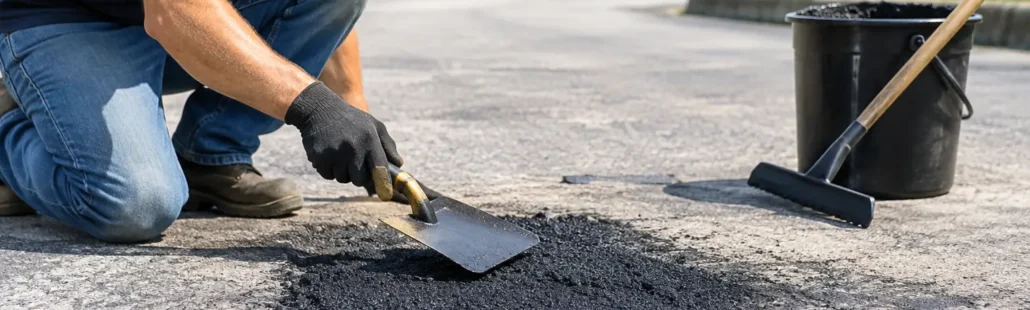
Small cold-lay products have a place as a short-term measure for minor holes or to reduce an immediate hazard. They are not a like-for-like substitute for a properly cut, prepared and compacted hot-lay tarmac repair, particularly on a trafficked edge. If a repair keeps breaking down, temporary material is unlikely to solve the underlying issue.
Choosing a contractor for edge repairs
Ask how the failed material will be removed, whether the base will be inspected and how the new edge will be supported. These details matter more than a promise to simply fill the gap. The quote should make clear whether drainage, excavation, edging and reinstatement of adjacent ground are included.
For commercial sites, consider access arrangements and disruption as well. A capable surfacing contractor can plan the work around deliveries, customers and operational hours, while keeping the repaired area safe during curing and reopening. EB Road Surfacing provides tarmac repairs and resurfacing for domestic and commercial sites, with the practical equipment and experience needed to deal with both local edge failures and larger deteriorated areas.
A crumbling tarmac edge will not improve with traffic and rainfall. Deal with it while the damage is contained, and the repair can be straightforward, tidy and far less costly than rebuilding a failed driveway or access road later.