Top Signs of Surface Failure to Watch For
A surface rarely fails all at once. It usually starts with a few hairline cracks, a patch that holds water after rain, or an edge that begins to crumble under tyres. Those early warnings matter. The top signs of surface failure are often easy to spot, but they are also easy to ignore until the repair becomes larger, more disruptive and more expensive.
For homeowners, that might mean a driveway that starts looking tired and becomes unsafe underfoot. For site managers and commercial property owners, it can mean trip risks, vehicle damage, drainage complaints and avoidable maintenance costs. The key is knowing what you are looking at and what it tends to lead to if left alone.
Why surface failure starts in the first place
Most surface problems are not random. They usually come down to traffic load, water ingress, age, poor drainage, sub-base movement, freeze-thaw weather and general wear. In some cases, a surface has simply reached the end of its working life. In others, the visible damage is a symptom of a deeper issue underneath.
That is why surface condition should never be judged on appearance alone. A small defect on a domestic driveway may stay manageable with prompt repair, while the same defect on a busy car park or access road can worsen very quickly under heavier use. The speed of deterioration depends on the type of traffic, the quality of the original installation and how well water is being carried away.
Top signs of surface failure
Cracking that keeps spreading
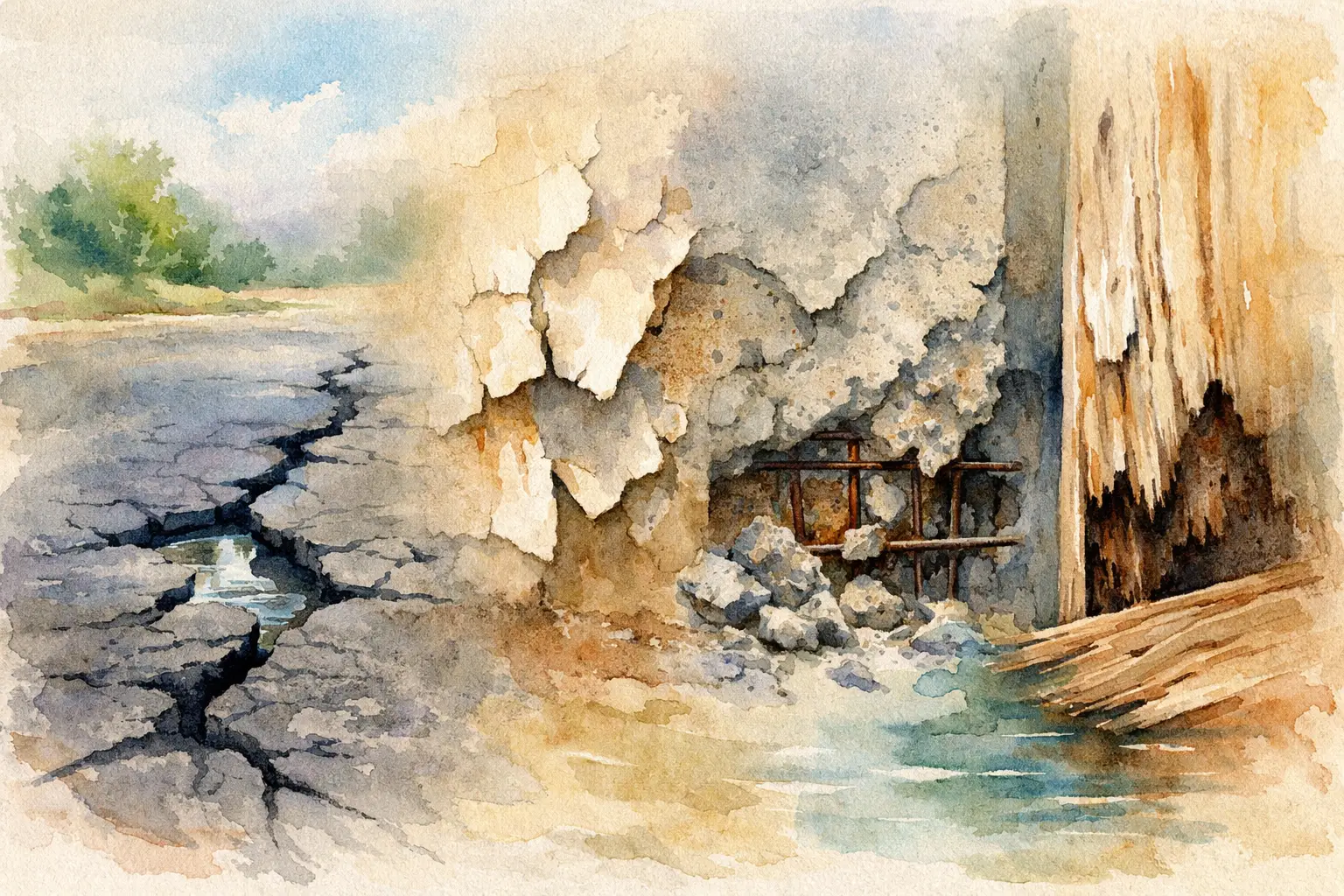
Cracks are one of the clearest early signs that a surface is under stress. Fine cracks can appear through ageing and weathering, but when they begin to widen, link together or form patterns, they often point to movement below the surface.
Long linear cracks may suggest weak joints or stress from repeated traffic. Interconnected cracking, sometimes described as crocodile cracking, is more serious and often indicates structural fatigue. Once water gets into those openings, the problem tends to accelerate. In colder conditions, trapped water can freeze, expand and force the surface apart further.
A few isolated cracks do not always mean full resurfacing is required. In some cases, targeted repair is enough. If cracking is widespread, however, patching alone may only delay the inevitable.
Potholes and localised break-up
Potholes are not just cosmetic damage. They are a clear sign that the surface has already broken down and that the material beneath is being exposed to water and traffic. That combination causes rapid worsening.
What starts as a small failed patch can become a safety issue very quickly, especially on routes used by delivery vehicles, customer traffic or regular turning movements. On driveways and private roads, potholes can also indicate that the sub-base is no longer providing proper support.
If potholes keep reappearing in the same area, the underlying issue may be drainage or foundation weakness rather than surface wear alone. Repeated filling without addressing the cause is rarely cost-effective in the long term.
Standing water after rain
Water should move off a surface, not sit on it. If puddles remain long after rainfall has stopped, that usually means the surface levels are no longer draining correctly or the drainage system itself is struggling.
Standing water shortens the life of asphalt and tarmac surfaces. It seeps into small openings, weakens the structure and increases the chance of cracking, edge failure and pothole formation. It also creates practical problems, from slip hazards to dirty splashback around entrances and pedestrian areas.
In some situations, minor low spots can be corrected locally. In others, the issue is broader and tied to settlement, poor falls or blocked drainage channels. It depends on whether the water problem is isolated or part of a larger pattern across the site.
Surface fretting and loose aggregate
If the top layer is beginning to wear away and leave loose stone or gritty debris behind, that is known as fretting. It often starts with a roughened appearance and can progress to more obvious material loss.
This type of wear is common on ageing surfaces, especially where weather exposure is high or the binder has begun to break down. It can also show up where vehicles brake, turn sharply or scrub the surface repeatedly. On commercial sites, that is often around entrances, loading areas and junction points.
Fretting matters because the wearing course is there to protect what sits below it. Once it begins to break up, water penetration becomes easier and the rate of failure increases.
Edge deterioration
A surface is often weakest at the edges. If the sides are starting to crumble, crack or break away, it may be because they are unsupported, overrun by vehicles or weakened by water.
Edge failure is common on rural access roads, driveways with soft verges and car parks where vehicles regularly cut corners. It is also something many property owners put off dealing with because the middle of the surface still looks usable. That can be a mistake. Once edges go, the damaged area tends to creep inward.
Early repair can often stabilise the problem. Left too long, it may mean more extensive reconstruction is needed along the perimeter.
Depressions, rutting and uneven areas
If wheel paths begin to dip or sections of the surface settle unevenly, that is a sign the structure is no longer holding shape as it should. On roads and car parks, rutting often appears where traffic is repeated in the same line. On domestic surfaces, depressions may form where the base was not compacted properly or where water has softened the support layers.
These defects are more than a visual problem. They affect drainage, create trip points and place extra stress on surrounding material. They can also hold water, which then feeds further deterioration.
Where deformation is minor, patching may help for a time. If the cause is poor support beneath the surface, a proper repair usually needs to go deeper than the top layer.
When appearance becomes a safety issue
One of the biggest mistakes people make is treating surface damage as a cosmetic concern only. In reality, the top signs of surface failure often overlap with safety and liability risks.
Cracks can catch heels and trolley wheels. Potholes can damage vehicles and create pedestrian hazards. Standing water reduces grip and can hide defects underneath. On commercial premises, these issues can affect visitors, staff, tenants and contractors. On private property, they can still create risk for household members, guests and delivery drivers.
The threshold between untidy and unsafe is not always dramatic. It is usually gradual, which is exactly why regular inspection matters.
Repair now or resurface later?
There is no one-size-fits-all answer. Some surfaces respond well to timely patch repairs, crack sealing or localised reinstatement. Others have reached the stage where repeated maintenance is only adding cost without solving the underlying problem.
A good rule is to look at the extent, not just the defect itself. If damage is confined to a small area and the surrounding surface is sound, repair is often the sensible option. If defects are appearing in multiple places, drainage is poor and the surface is ageing across the board, resurfacing may be the more economical route.
This is where a professional assessment helps. A contractor should be looking at use, drainage, construction depth, existing wear and what result you actually need. A private driveway and a busy commercial yard may show similar symptoms but need very different solutions.
What to do if you spot early failure
The best response is not always immediate full replacement, but it should be timely action. Leaving small defects through another wet season, or through repeated heavy use, usually narrows your options and raises the final cost.
Start by noting where damage is appearing and whether it is getting worse. Check after rainfall to see how water behaves. Pay attention to entrances, turning areas, edges and places where traffic slows or stops. Those are common failure points.
If you manage a larger site, regular inspections are worth building into planned maintenance. If you own a driveway or private access road, it helps to deal with defects while they are still localised. Companies such as EB Road Surfacing are often called in after a surface has gone past the stage of simple repair, when earlier intervention would have been more straightforward and less disruptive.
A sound surface should drain properly, carry traffic safely and keep its shape under normal use. Once it stops doing those basic jobs, the warning signs are already there. Catch them early, and you usually have more practical, affordable options on the table.