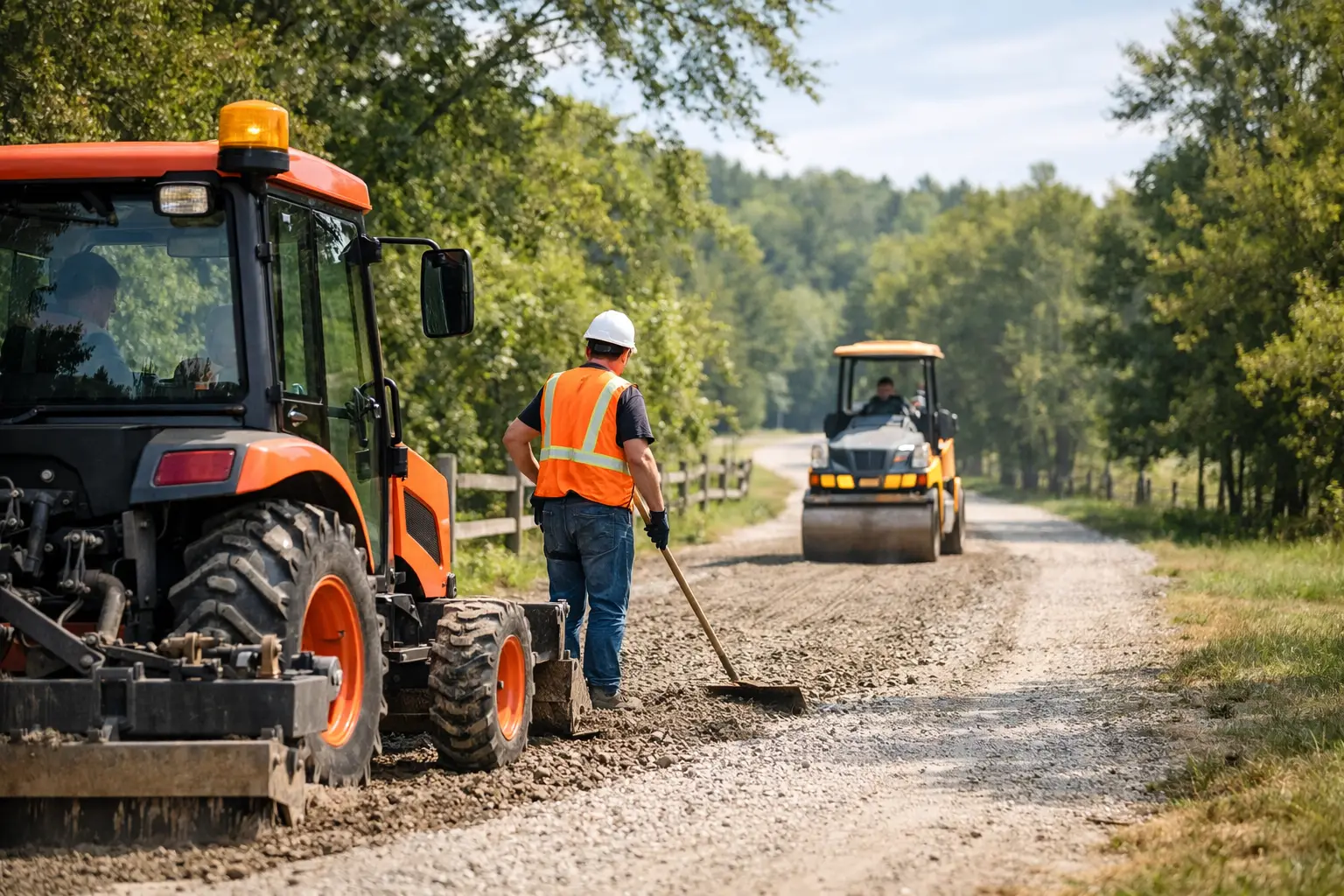
A Practical Guide to Private Road Maintenance
A private road rarely fails all at once. It starts with a blocked gully, a shallow rut where vehicles brake, loose edges or a crack that lets water beneath the surface. Left through a Scottish winter, those small defects can quickly become potholes, standing water and expensive access problems. This guide to private road maintenance explains what responsible owners and site managers should check, when repairs are enough and when resurfacing is the better long-term decision.
Private roads carry more responsibility than many people expect. Whether they serve homes, farms, industrial units, retail premises or a managed development, the people responsible must keep the route safe, accessible and fit for the traffic using it. A planned approach protects the surface, reduces disruption and gives you a clearer basis for budgeting.
Start with responsibility and a condition survey
Before arranging works, establish who owns the road and who is responsible for maintenance. On an unadopted road, this may be a single landowner, a management company, a group of residents, or businesses with rights of access. Deeds, title plans and existing maintenance agreements should clarify the position. If several parties use the route, agree how decisions and costs will be handled before defects become urgent.
A proper visual survey is the next practical step. Walk the full length of the road and note the location, size and likely cause of every defect. Photographs taken after heavy rain can be especially useful, as they show where water is collecting and whether drainage is working as intended.
Look for cracking, fretting, potholes, depressions, wheel-track rutting, loose verges and failing edges. Also check covers, gullies, kerbs, entrance points and any area used by delivery lorries or refuse vehicles. These locations often receive more loading than the rest of the road and may need a stronger repair specification.
Drainage comes before surface repairs
Water is one of the main causes of premature road failure. If rainwater cannot leave the surface and underlying layers, it weakens the foundation of the road. Traffic then flexes the damp material below, breaking up the tarmacadam from underneath. Filling the visible hole without solving the water problem may only provide a short-lived result.
Check that gullies, channels and ditches are clear of leaves, silt and debris. Confirm that road falls direct water towards drainage points rather than into gateways, properties or the centre of the carriageway. On rural access roads, grips and drainage ditches can be as important as the paved surface itself.
Where water repeatedly sits in the same place, the road may have lost its profile or the drainage system may be undersized, blocked or damaged. The right solution could be clearing and repairing drainage, reinstating crossfall, installing channels, or rebuilding a local section of the road. The best option depends on ground conditions, traffic levels and where the water can legally and safely discharge.
Why patching around standing water often fails
A patch laid over saturated ground can look tidy on completion but deteriorate quickly under vehicle weight. For a lasting repair, damaged material needs to be cut back to sound edges, weak layers removed and the base rebuilt where necessary. The finished surface should then be compacted correctly and tied into the existing road so water cannot track into the joint.
Match the maintenance method to the defect
Not every private road needs full resurfacing. Timely, targeted maintenance is usually the most cost-effective way to extend its service life. The key is to choose work that addresses the condition below the surface as well as the visible damage.
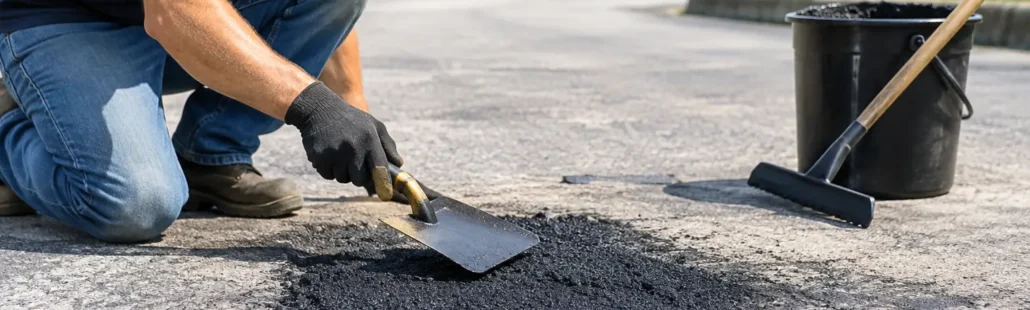
Small cracks should be dealt with early. Sealing suitable cracks can prevent water ingress, but widespread cracking often signals that the surface is ageing or the base is moving. Pothole repairs are appropriate where failures are isolated and the surrounding road remains sound. A professional repair involves more than throwing material into a hole: the area must be squared off, cleaned, prepared, filled with the correct material and compacted to the right level.
Surface dressing can be a sensible treatment for a structurally sound road with a worn or weathered finish. It restores texture and helps seal the surface, but it will not correct significant potholes, deformation or base failure. It is a preservation measure, not a substitute for reconstruction.
Resurfacing becomes more appropriate where defects are widespread, the road is breaking up over long stretches, or repeated patches are creating an uneven, untidy route. Depending on the survey, this may involve planing off the failed surface and laying new asphalt, or excavating and rebuilding deeper layers in weak areas. Full reconstruction costs more initially, but can be better value than paying for recurring call-outs and disruptive repairs.
Plan maintenance around how the road is used
A lightly used residential lane and an access road serving a warehouse should not be maintained to the same specification. The road design needs to reflect actual use, not just its appearance on the day of inspection.
Consider the weight and frequency of vehicles, including bin lorries, delivery vehicles, emergency services, agricultural machinery and construction traffic. One heavily loaded vehicle can do more damage than many cars if the road was built only for light domestic use. Junctions, turning heads, loading areas and entrances may require thicker or stronger construction because vehicles brake, turn and apply concentrated force there.
Traffic management also matters during repairs. A contractor should plan access for residents, staff, customers and emergency vehicles, particularly where there is no alternative route. Smaller repairs can often be phased with minimal disruption. Larger resurfacing schemes may need temporary closures or controlled access, but a clear programme makes the process far easier to manage.
Do not overlook road markings and edges
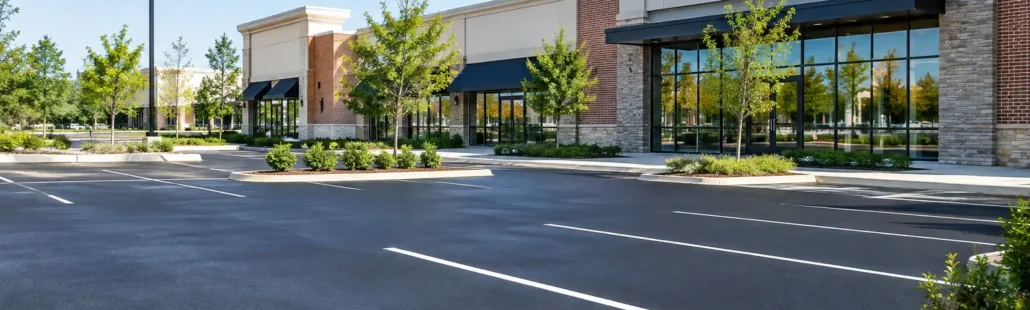
Faded lines, unclear parking bays and worn pedestrian routes create avoidable safety issues on commercial or shared sites. Once the road surface is repaired or resurfaced, line marking can improve traffic flow, define parking and loading areas, and make hazards easier to see.
Road edges deserve the same attention. Unsupported edges crack under tyres, especially where vehicles pull over or pass each other on narrow lanes. Edge repairs, kerbing or suitable verge reinforcement can prevent the carriageway from progressively breaking away.
Set a simple inspection routine
Private road maintenance is easier to control when inspections are planned rather than triggered by complaints. For most shared or commercial routes, a basic monthly visual check and a more detailed inspection after severe weather is a sensible starting point. Higher-traffic roads may need more frequent checks.
Keep a record of defects, photographs, dates, weather conditions and completed repairs. This provides a useful history when deciding whether individual patches are still worthwhile or the road has reached the point where resurfacing is more economical. It also helps management companies and landowners explain maintenance decisions fairly to users who contribute towards costs.
In autumn, prioritise clearing gullies and channels before leaf fall causes blockages. After frost, snow or prolonged rain, check for new potholes, loose material and water damage. In spring and summer, use dry conditions to complete planned surfacing works, renew markings and deal with defects before the next wet season.
Choose a contractor on specification, not price alone
The cheapest quote is not always the lowest-cost outcome. A quote should clearly state the preparation work, excavation depth where required, materials, drainage measures, compaction and reinstatement included. If these details are vague, it is difficult to compare proposals properly.
Ask whether the contractor has experience with roads of similar use, carries appropriate insurance and provides a workmanship guarantee. For larger jobs, a site visit and condition assessment are essential. A dependable contractor will explain whether a repair, overlay or full reconstruction is justified, rather than recommending the same solution for every road.
EB Road Surfacing carries out private road repairs, resurfacing, drainage-related remedial work and road marking across Scotland and Northern England. The right scope is always based on the road’s condition, traffic and drainage, with work planned to keep disruption under control.
When urgent action is needed
Some defects should not wait for a planned maintenance cycle. Deep potholes, loose surfacing, flooding, collapsed edges, damaged drainage covers and obstructions can create immediate risks for pedestrians, cyclists and vehicles. Make the area safe where possible, restrict access if necessary, and arrange a professional assessment promptly.
A well-maintained private road is not simply better to look at. It keeps homes, businesses and services accessible, reduces trip and vehicle-damage risks, and avoids the false economy of repeated temporary repairs. Deal with water early, record defects properly and invest in the level of repair the road genuinely needs – that is how an access route stays dependable year after year.