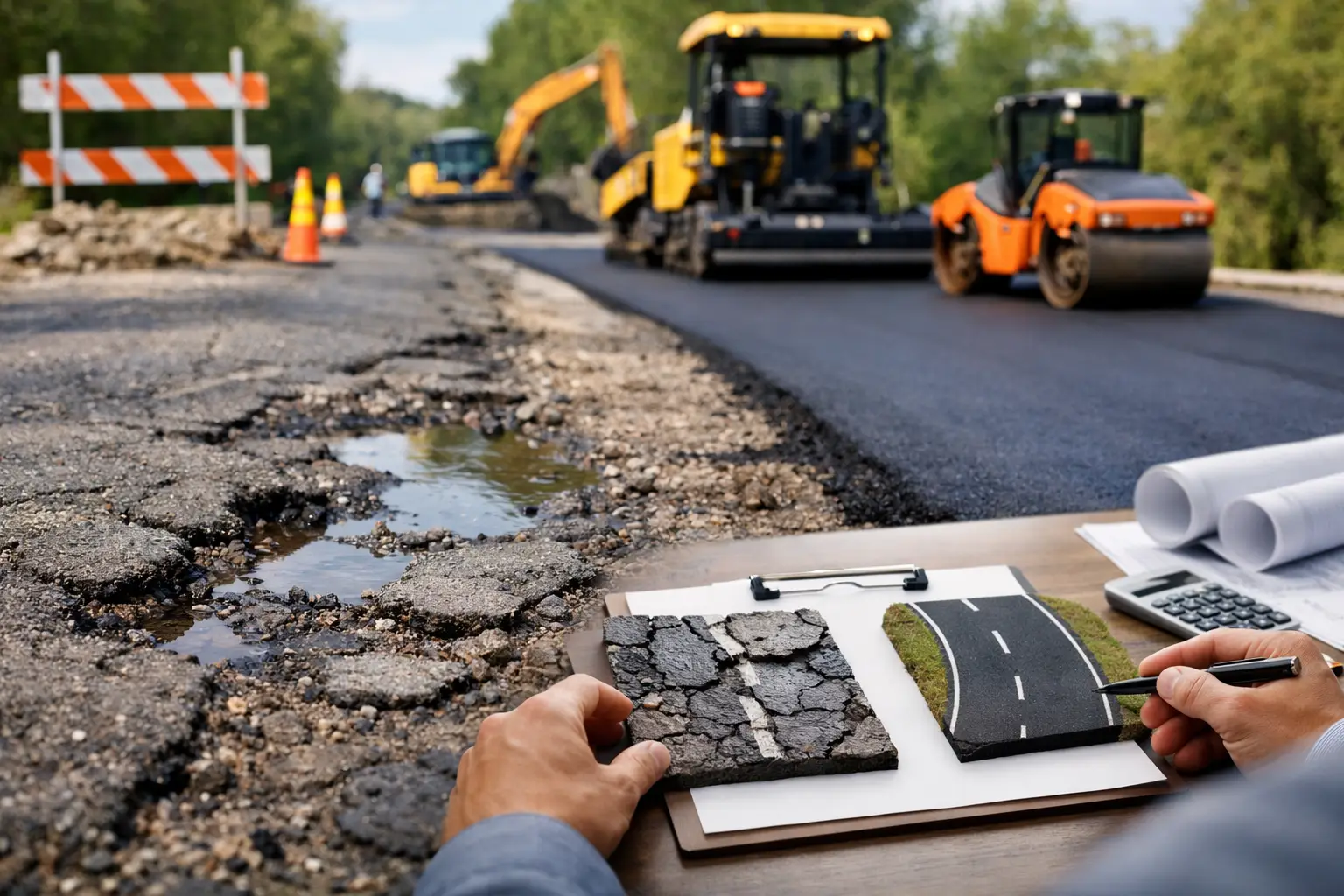
Private Road Repairs or Replacement Decisions
A private road is easy to overlook until a pothole damages a vehicle, loose stone creates a slip risk, or standing water makes access difficult. Deciding between private road repairs or replacement is not simply a question of price. The right answer depends on the condition of the existing surface, the road base beneath it, drainage, traffic levels and who is responsible for the route.
For homeowners, landowners and site managers, early action is usually the most cost-effective option. Local defects can often be repaired before water reaches the foundation layers. Once the road begins to fail across a wider area, repeated patching can become poor value and a planned resurfacing project may offer the more durable result.
Start with the cause, not the visible damage
Cracks, potholes and worn patches are symptoms. A reliable repair starts by identifying why they have appeared. Traffic loading from delivery vehicles, bin lorries, farm machinery or regular commercial use can quickly expose a surface that was designed only for light domestic traffic. Water is equally damaging. If it sits on the road or enters cracks, it can weaken the layers beneath the tarmac and cause the surface to break apart.
Poor drainage, blocked gullies, damaged edges and an inadequate fall across the carriageway are common problems on private access roads. In colder weather, trapped water can freeze and expand, widening existing cracks. Simply filling the hole without addressing the water route may improve the appearance for a short time, but the defect is likely to return.
A site inspection should assess the full length of the road, not only the worst area. It should consider the condition of the sub-base, the depth and type of existing surfacing, edge support, drainage points and the vehicles using the route. This gives owners a clearer basis for choosing repair, resurfacing or full reconstruction.
When private road repairs are the sensible choice
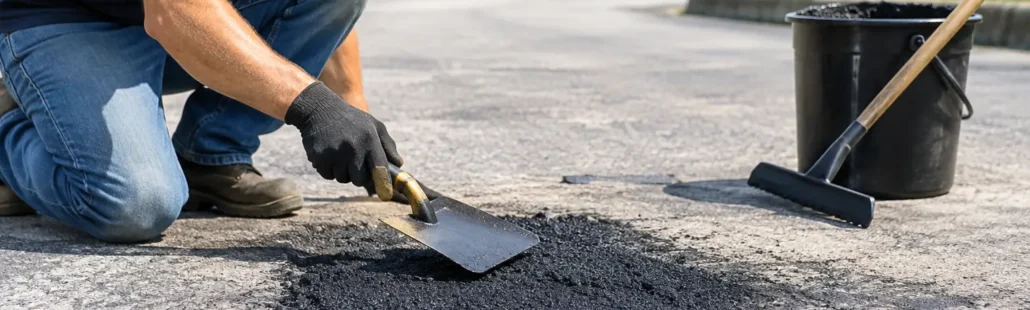
Targeted repairs work well when the rest of the road remains structurally sound. A limited number of potholes, isolated cracking, minor surface fretting or a localised failed edge can often be cut out, cleaned, prepared and reinstated with suitable tarmacadam. The finished repair should be compacted properly and tied neatly into the surrounding surface to prevent water entering at the joint.
Pothole repairs are particularly effective where damage has a clear local cause, such as water running from a damaged drain cover or a section repeatedly used by heavy vehicles. Addressing that cause at the same time protects the new repair.
Surface dressing may also be appropriate for a road that is fundamentally stable but has become weathered, slightly worn or lacking skid resistance. It renews the wearing surface and helps seal minor imperfections, although it will not correct deep potholes, soft areas or major drainage failures.
Repair work offers lower upfront cost and can usually be completed with limited disruption. However, it is only good value when the surrounding road has enough strength to support it. If new patches are appearing every season, the maintenance budget may be better directed towards a wider solution.
Signs replacement or full resurfacing is needed
Replacement does not always mean excavating every layer and building the road again. In many cases, resurfacing involves removing failed areas, regulating uneven sections and laying a new asphalt surface across the existing road. Where the foundation is sound, this can restore a safe, consistent finish without the cost of full reconstruction.
A more extensive programme should be considered when defects are widespread, the road has numerous previous patches, water ponds in several areas, or the surface is uneven over long stretches. Alligator cracking – an interconnected pattern of cracks resembling a reptile’s skin – often indicates movement or weakness below the surface. Soft spots, wheel-track depressions and crumbling edges are further signs that a simple patch may not last.
Full reconstruction becomes necessary where the sub-base has failed, the road has insufficient depth for its traffic, or drainage has caused prolonged saturation. This work may include excavation, formation repairs, new aggregate sub-base, improved drainage and fresh base and wearing courses. It costs more initially, but it provides the opportunity to correct the underlying cause rather than repeatedly treating the symptoms.
The role of drainage and road edges
Drainage is often the deciding factor in whether a new surface performs as intended. A private road needs a clear route for water to leave the carriageway. Depending on the site, that may mean restoring gullies, cleaning channels, installing drainage runs or adjusting levels so water falls away from buildings and access points.
Road edges also need proper support. On narrow rural access roads, vehicles may run close to the verge and break the edge of the tarmac. Once an edge fails, water can work beneath the surface and the damage can travel inwards. Strengthening the edge, improving the verge detail or widening a passing point can reduce future maintenance issues where vehicles have limited room to manoeuvre.
Any drainage work must suit the site and avoid moving water towards neighbouring land or property. This is particularly relevant on shared private roads, where a practical solution should protect all users, not shift the problem further along the route.
Private road ownership and shared responsibility
Before commissioning work, establish who owns the road and who has responsibility for maintaining it. The answer may be set out in title documents, leases, deeds of conditions or agreements between neighbouring owners. A road used by several properties can involve shared rights of access and shared maintenance obligations, even where one person owns part of the land.
Clear communication avoids delays and disagreements. If several owners contribute, agree the scope of work, the standard of finish, access arrangements and cost allocation before the contractor is booked. It is also sensible to confirm whether services, drainage covers, gates or boundaries could affect the work.
For commercial estates, farms, housing developments and managed sites, consider the road as part of wider safety and operational planning. A damaged access route can affect deliveries, emergency access, visitor safety and the presentation of the site. Planning work around peak operating hours can keep disruption under control.
Choosing the right surface and specification
There is no single specification that suits every private road. A short driveway serving cars needs a different construction from a long estate road used by refuse vehicles, delivery lorries and contractors. The key is to match the road build-up and surface material to expected traffic, ground conditions and drainage requirements.
Tarmacadam and asphalt remain practical choices for many access roads because they provide a smooth, durable surface that can be repaired or renewed when required. A correctly specified surface is more valuable than a cheap layer laid over failing ground. Thickness, preparation, compaction and edge detailing all influence how long the work will last.
Cost should therefore be judged over the expected service life, not only against the first quotation. A lower price can become expensive if it excludes essential excavation, drainage improvements or proper preparation. A detailed quote should explain the areas to be repaired or resurfaced, the proposed materials, any removal of failed sections and the expected programme of work.
Planning the work with minimal disruption
Access is the practical issue on most private road projects. Residents may need to reach their homes, businesses may require delivery routes, and rural properties may need to accommodate livestock, agricultural machinery or emergency services. A competent contractor will plan sequencing around these needs, complete work in manageable sections and explain when access restrictions are unavoidable.
Weather also matters. Surfacing should be carried out in suitable conditions so the material can be laid and compacted correctly. This does not mean every project must wait for summer, but it does mean programming should allow for the site conditions and the nature of the repair.
EB Road Surfacing provides private road repairs, resurfacing and reconstruction work across Scotland and Northern England, with a focus on practical preparation, durable materials and clear project planning. Whether the issue is a few growing potholes or a road that has reached the end of its working life, the most useful next step is a proper assessment of the ground beneath the damage. That allows the work to be priced fairly, planned properly and built to keep the route safe and usable for years to come.