The Warehouse Yard Drainage Case for Early Repairs
A loading bay can look serviceable at 7am and become a safety issue by lunchtime. Water collecting around dock doors, wheel paths and pedestrian crossings slows deliveries, weakens the surface and creates avoidable risk for staff, visitors and hauliers. This warehouse yard drainage case is straightforward: dealing with drainage early is usually cheaper and less disruptive than waiting for standing water to damage the yard.
For warehouse operators, drainage is not a separate concern from surfacing. The fall of the asphalt, condition of gullies, kerbs, channels and outlet pipes all determine whether water leaves the site as intended. When one part fails, the result is often visible on the surface first – puddling, cracking, potholes, loose edges and areas that remain wet long after rainfall has stopped.
The Warehouse Yard Drainage Case for Planned Action
A busy yard is designed around movement. Forklifts need clear routes, articulated lorries need sound turning areas, and loading operations need safe footing close to vehicles and dock entrances. Water in the wrong place interferes with every one of those activities.
The immediate concern is slip and skid risk. In colder weather, trapped water can freeze, while pooled water can conceal potholes, failed ironwork and uneven levels. It also carries debris towards gullies, accelerating blockages and increasing the likelihood that the next period of heavy rain will cause flooding rather than simply slow drainage.
The longer-term cost is normally in the pavement. Water entering cracks and open joints can soften the layers beneath an asphalt yard. Under repeated heavy axle loads, the weakened area begins to deform, crack or break away. What could have been a local drainage repair may then require excavation, reinstatement of the base and resurfacing over a wider section.
There is also an operational cost. A flooded loading area may force vehicles to queue or be diverted, particularly where a yard has limited circulation space. Closing a bay for emergency repairs is rarely convenient. Planned work gives site managers more control over timing, traffic management and access.
Why Warehouse Yard Drainage Problems Develop
Drainage issues are not always caused by a single blocked gully. On older sites, several small defects often combine. A surface may have settled in wheel tracks, leaving a low point beyond the reach of existing channels. Kerb lines may have been damaged by vehicle contact. Gullies can be full of silt, leaves or packaging debris, and outlet pipes may be restricted or damaged.
Surface repairs can also alter how water moves. If patching has been carried out repeatedly without checking levels, the repaired area may sit proud of the surrounding asphalt and redirect water towards buildings, thresholds or pedestrian routes. Equally, resurfacing without suitable falls can leave a clean-looking yard that still holds water after rain.
Heavy vehicle use makes these defects more severe. A car park may tolerate minor puddling for some time, but loading yards experience regular braking, turning and standing loads from lorries. Water and traffic together quickly expose weak construction or poor drainage levels.
Warning Signs Worth Acting On
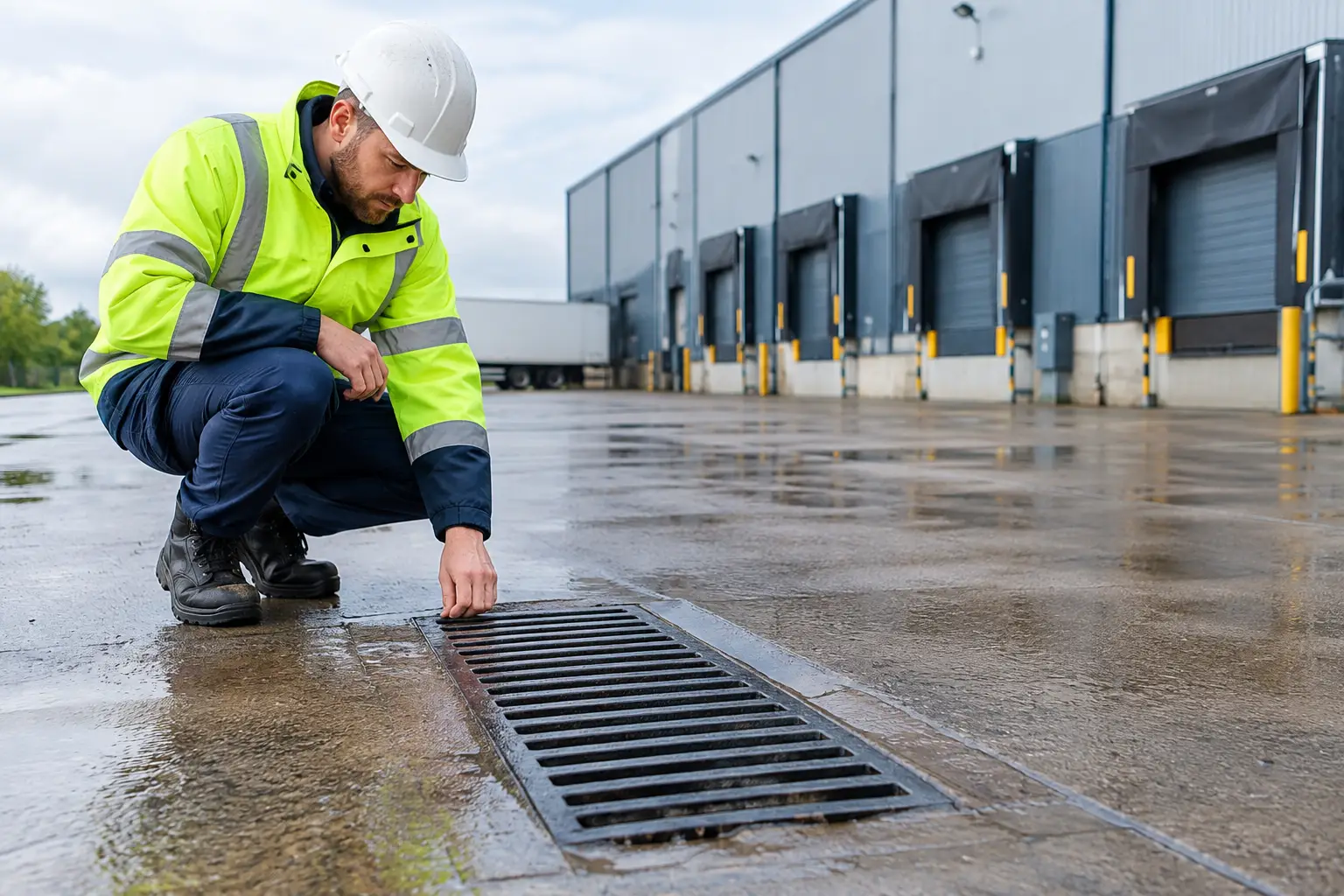
Standing water for more than a short period after rainfall is the clearest sign, but it is not the only one. Repeated potholes in the same area, crumbling edges around gullies, sunken wheel tracks, algae growth, mud trails and water marks on building walls all deserve investigation.
Site teams should also pay attention to operational evidence. If drivers avoid a particular route, staff report slippery ground, or a gully needs clearing after every storm, the issue is likely beyond routine housekeeping. A proper survey can establish whether the cause is surface level, drainage capacity, a blockage or a combination of all three.
Start With the Whole Water Route
The right repair depends on where water is entering, where it is collecting and where it should discharge. Treating only the visible puddle can be false economy if the outlet remains blocked or the surrounding surface continues to direct water back to the same point.
A competent assessment looks at the yard in use and, where possible, after rain. It should identify traffic routes, loading areas, pedestrian crossings, existing gullies and channels, kerb lines, thresholds and known flooding points. Falls and levels then need checking to establish the natural route of surface water.
The condition and capacity of the drainage system matter as much as the top layer. Gullies may need cleaning, repair or replacement. Channel drains may need new grates suitable for the expected loading. Pipework may require investigation before major surfacing work starts. There is little value in installing new drainage features if the downstream system cannot carry the water away.
Discharge arrangements must be considered carefully. Depending on the site, drainage may connect to an approved surface water system, a soakaway or a sustainable drainage feature. Requirements vary by location and site conditions, particularly where alterations affect existing drainage or involve new development. A contractor should work to the agreed design and ensure the proposed solution is appropriate for the site.
Choosing the Right Repair Approach
For a localised problem, gully cleaning and repairs combined with targeted asphalt reinstatement may be enough. If the surface around a gully has failed, the damaged material can be excavated, the drainage unit reset at the correct level and the surrounding area rebuilt to restore a smooth, draining finish.
Where water is collecting along a building edge or crossing a route, a channel drain may provide a more controlled collection point. This can be effective at loading doors and entrances, but it must be designed for vehicle loading and positioned so that the surface falls towards it. Poorly placed channels simply add another feature for traffic to damage.
If a larger section of yard has lost its levels, planing and resurfacing may be the better answer. This allows the new asphalt to be laid with suitable falls towards gullies or channels, while removing cracked and uneven material. In areas affected by heavy lorries, the underlying construction may need strengthening as well. Laying a fresh surface over soft or water-damaged layers will not provide a lasting result.
For sites with broader runoff concerns, permeable paving, attenuation or other sustainable drainage measures may be worth considering. These options can reduce pressure on conventional drainage, but they are not suitable for every heavy-duty yard. Ground conditions, contamination risk, maintenance arrangements and the type of traffic all affect the decision.
Keep the Yard Operating During the Works
Drainage and resurfacing projects do not have to mean closing an entire distribution site. The practical approach is to divide the work into manageable areas, maintain safe vehicle routes and schedule disruptive activities around delivery patterns where possible.
A clear plan should cover access for lorries, segregation for pedestrians, delivery times, curing periods and any temporary changes to loading arrangements. Site managers should provide the contractor with accurate information about peak movements, turning requirements and restricted areas before work begins. This prevents a technically sound repair from causing unnecessary operational problems.
Communication is equally important. Drivers, warehouse staff and visitors need to know which routes are open, where traffic is being redirected and when access will return to normal. Good traffic management protects the workforce and gives the new work time to perform properly before heavy use resumes.
Prevention Costs Less Than Repeated Emergency Repairs
Once the yard is draining correctly, regular inspection helps protect the investment. Gullies and channels should be cleared before autumn leaf fall and checked after severe weather. Any cracking around drainage points should be repaired promptly, as these joints are common routes for water to enter the construction below.
Facilities teams should avoid allowing loose materials, pallets or waste to obstruct drainage runs. Vehicle impacts on kerbs, channels and gully grates should be recorded and addressed, rather than left until the next major maintenance programme. Small defects are more affordable to correct while the surrounding asphalt remains sound.
EB Road Surfacing can assess drainage-related surface failures and carry out practical repairs, drainage reinstatement and resurfacing works for commercial yards across Scotland and northern England. The focus should always be on a solution that suits the site’s traffic, drainage layout and working hours, not a one-size-fits-all patch.
A dry, even yard is not simply better looking. It gives vehicles predictable traction, keeps loading operations moving and helps the asphalt last as it should. When water begins to linger where lorries and people need to work, that is the right time to arrange an assessment – before the next storm turns a minor defect into a larger closure.